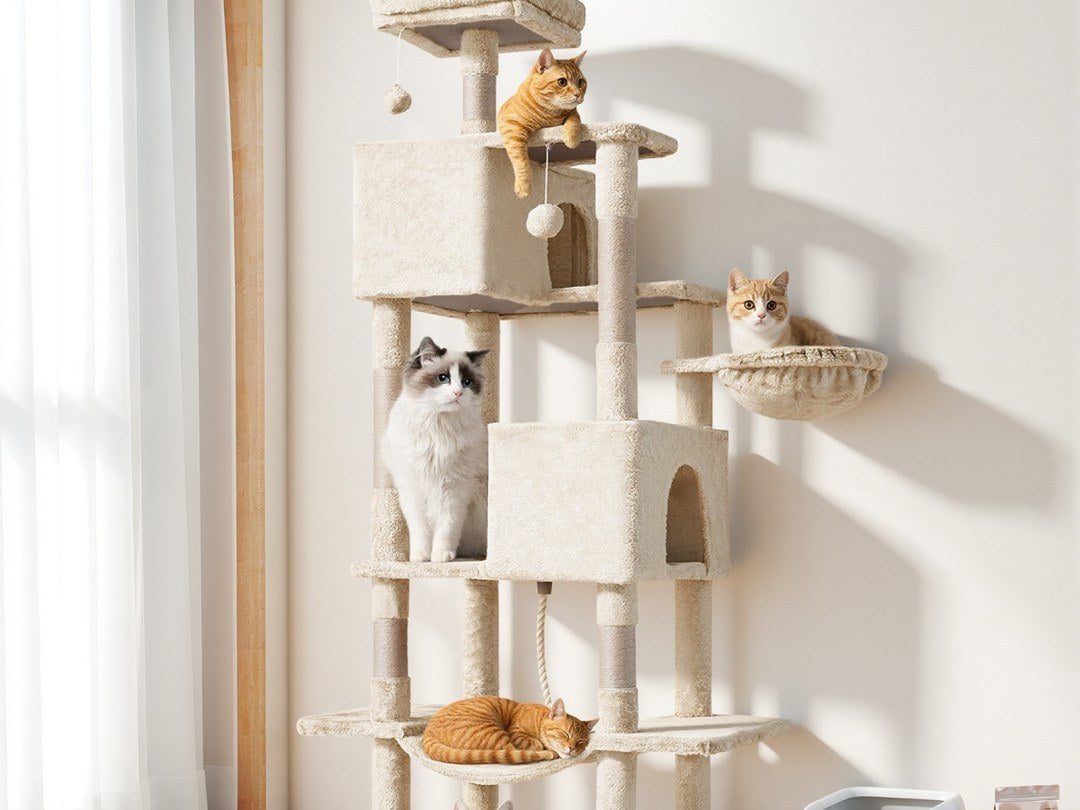
A cat tree works for two or more cats when every cat can find a place of its own, at more than one height, on a frame strong enough to carry them all at once. In practice that means enough separate resting spots, weight ratings that cover your cats in total and on each level, a height and base that suit your room, sisal for scratching, and a way to secure the tower to a wall.
Get those right and the tree becomes shared ground rather than a contest.
Why do cats compete for the highest spot?
Height matters to cats. A high perch gives a wide view of the room, distance from the traffic on the floor, and a place to rest without being approached from every side.
With several cats, height is also how a room gets shared: cats spread upward as well as across the floor, so a tall tree adds territory without taking much more floor.
Trouble tends to start when there is only one good high spot: one cat holds it while the others wait or give up. More separate places, at more than one height, give every cat a reasonable option and can help ease that friction. A tree will not settle every disagreement, but a crowded one rarely helps.
How many resting spots and scratching posts do several cats need?
A sensible starting point is one separate resting place per cat, plus a spare, so the cat who arrives last still has a choice. Separate is the key word: one wide platform that puts cats side by side is not the same as two spots with some distance between them.
Variety helps too: some cats want an open perch with a view, some the walls of a condo, some a hammock or basket.
Scratching belongs on the list. It is normal behavior that keeps claws in condition, gives a good stretch and leaves a cat's scent behind. Sisal wrapped posts offer a firm, textured surface many cats like, and a second scratcher in another room means no cat has to wait for the only one.
What weight rating does a cat tree need for more than one cat?
Check two numbers. The total rating is what the whole tree carries with every cat on it at once, so add up your cats' weights and make sure the sum sits within it, ideally with room to spare.
The per level rating is what one perch or hammock carries. It matters for your heaviest cat, and for any two cats who curl up together in the same spot: their combined weight should sit within it too.
If you are unsure of their weights, weigh yourself holding each cat and subtract your own weight. If you are close to either limit, choose a tree rated higher.
How much ceiling height and floor space does a cat tree need?
Measure before you choose. Check the tree's full height against your ceiling and against anything overhead in that spot, such as a shelf or a ceiling fan, and leave room above the top perch for a cat to sit up comfortably.
Then check the base against your floor. The footprint should fit without being wedged in, with clear floor around it so cats land on open space rather than on furniture or a hard edge.
Where should a cat tree go, and should it be anchored to the wall?
Put it where the family actually spends time, close to a window if you can. A tree tucked away in a spare room is often ignored. Avoid narrow hallways and doorways, where one cat on the tree can control the way past it.
For a tall tree shared by several cats, anchoring it to the wall is a sensible step. Cats leap on and off at speed, sometimes two at once, and that force lands well above the base. Use the hardware that comes with the tree, follow the instructions, and check the fittings now and then, since daily climbing can work them loose.
Then give your cats time, with a few treats on the lower levels to invite them up. If a cat starts hiding much more than usual, changes its eating or litter habits, or tension between your cats grows, speak to your vet.
Which cat tree suits a family of three or four cats?
The Spire 66-Inch Cat Tree is built for three or four cats. It stands 66.93 in tall on a base of 22.83 x 18.90 in, and gives your cats seven separate places to rest: three perches, two condos, a slung hammock and a round basket. It has sisal wrapped posts and two hanging pompoms, on a particleboard frame under a plush cover.
It is rated to 44 lb in total, with each perch and the hammock rated to 22 lb. An anti tipping kit is included for securing the tower to a wall. Assembly is required, with labeled components and step by step instructions. It comes in dark grey, light grey or beige, and ships from a US warehouse.
It is not the right tree for every family. If your cats together weigh more than 44 lb, choose a tree rated higher or give them more than one. Four cats at 11 lb each already reach that limit. If your ceiling is low or sloped where it would stand, you cannot spare clear floor around that base, or you cannot secure it to a wall, a shorter, smaller tree will suit you better.
The short version
Give each cat its own spot at more than one height, keep every cat within the ratings, fit the tree to your room with space to spare, and secure it to a wall.
| Your situation | Best fit |
|---|---|
| Two to four cats weighing 44 lb or less together, in a room with height to spare | The Spire 66-Inch Cat Tree, secured to the wall |
| Cats weighing more than 44 lb together | A tree with a higher total rating, or more than one tree |
| A low or sloped ceiling, or a tight corner | A shorter tree with a smaller base |
| An older cat, or one that finds jumping harder | Lower resting spots, and a word with your vet |
If your cats and your room fit those numbers, the Spire 66-Inch Cat Tree has a separate spot for each of them, and our comfort collection has beds for the floor below.
Keep reading

Dog Ramp or Dog Stairs: Which Is Better for Your Dog?
Ramp or stairs for a dog that struggles to jump? When each suits, how to measure a bed, couch or car, and how to teach your...

How a Sliding Glass Door Pet Door Works, and Whether It Fits Yours
How a sliding glass door pet door stands in your door track, how to measure the track and your pet, and when a panel insert is...

Catio or Cat Enclosure: How to Give an Indoor Cat Safer Time Outside
Walk-in catio or tiered enclosure? How to measure, add shade, water and a hiding place, check for gaps and toxic plants, and ease your indoor cat...