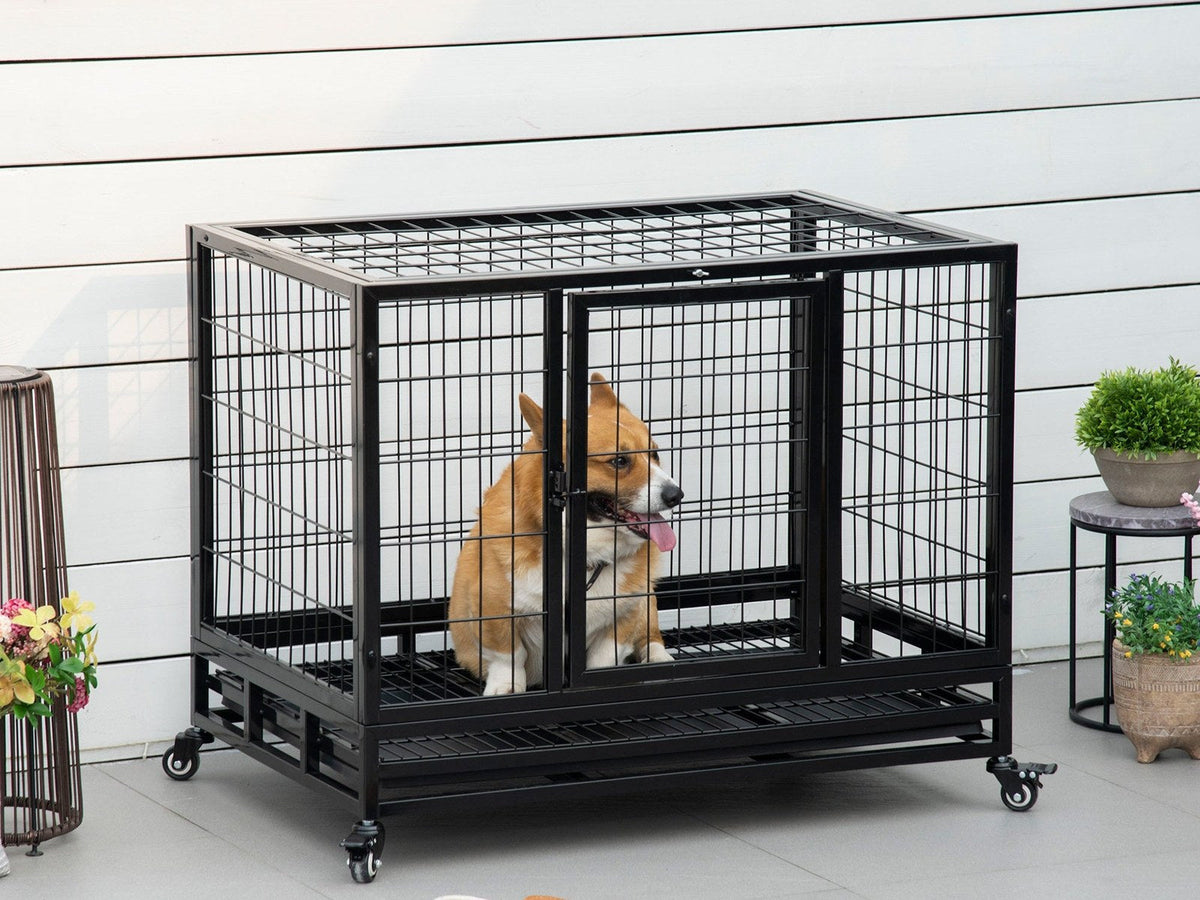
The right crate lets your dog stand up without ducking, turn around and lie down stretched out, while still feeling snug enough to be a den. To find that size, measure your dog's length from the nose to the base of the tail and its height while sitting and at the shoulder, then add a few inches of room. Check the weight limit too.
Here is how to measure, how to plan for a puppy, and how to tell when a crate is not the answer.
How do you measure your dog for a crate?
Use a soft tape measure, a few treats and, ideally, a helper. Measure when your dog is calm.
- Length: with your dog standing, measure from the tip of the nose to the base of the tail. Leave the tail itself out.
- Sitting height: with your dog sitting tall, measure from the floor to the top of the head, or to the ear tips if the ears stand upright.
- Shoulder height: with your dog standing, measure from the floor to the top of the shoulder blades. Many crates state their fit this way.
- Weight: weigh yourself holding your dog, then subtract your own weight. Your vet's scale is more accurate.
Measure twice, in inches and pounds, and keep the larger figure.
How much extra room should a crate have?
The common practice is to add a few inches, often around 2 to 4, to your dog's length and sitting height. That margin lets a dog stand, turn and lie down without pressing against the bars.
Compare your numbers with the inside dimensions, not the outside ones. Where a crate states the size of dog it suits, go by that first.
Bigger is not automatically kinder, though. For some dogs, particularly puppies in house training, too much spare room works against the process. Dogs generally avoid soiling where they sleep, but a long crate can offer a bed at one end and a toilet corner at the other. Some dogs also settle better in a space that feels enclosed. Aim for comfortable, not cavernous.
What size crate should you buy for a puppy?
Buy with the adult dog in mind, because puppies can outgrow a crate quickly. Your vet can give you a sense of how big your puppy is likely to get. Mixed breeds are harder to predict, so leave more margin.
The catch is that an adult-sized crate is often too roomy for a young puppy. The usual fixes are a divider that shrinks the space and moves back as the puppy grows, or a smaller crate now and a larger one later. A trainer can help you choose. If your puppy is very small, also check the gaps between the bars against its paws and muzzle.
Will the Keep 36-inch crate fit your dog?
The Keep 36-Inch Heavy-Duty Dog Crate is a black metal crate with a tube frame, welded bars and 1.8 in bar spacing. It measures 36.2 x 24.4 x 27.2 in overall, and the inside space is 34.3 x 22.8 x 20.1 in.
It is made for dogs under 25.6 in long, 13.8 in tall at the shoulder and 66 lb. Treat those as three separate limits: a dog that clears two but not the third needs a different crate.
- A front door 14.2 in wide and a top door 34.3 x 22.8 in, each with a latch. We do not quote a front door height because the published figures conflict.
- A slide-out tray, 34.3 x 22.4 in.
- Four 360 degree swivel casters, two of them lockable.
- The crate weighs 38.58 lb and needs assembly.
- The box holds the crate and a manual, with no bed or pad, so plan bedding separately.
- It ships from a US warehouse.
It is not the right crate for a dog over any one of those limits, or for a puppy likely to grow past them. A very young puppy far below them may find it too roomy at first. And at 38.58 lb, it is not a crate to lift and carry often.
How do you make a crate feel like a calm den?
Place it somewhere quiet but not isolated, near where the family spends its time and away from direct sun, heaters and drafts. A crate in a far, empty room can feel like being sent away.
Add soft bedding your dog already likes and something that smells of home. If your dog chews or swallows fabric, ask your vet or trainer what is safe to leave inside.
Introduce it slowly: door open, a treat tossed inside, a meal beside it and then in it. Close the door for a few moments while you stay close, and build from there.
Never use the crate as punishment. A crate works because a dog feels safe there, and sending a dog in after a scolding teaches the opposite. Ask your vet how long your dog can comfortably stay crated, since it depends on age and needs.
When is a crate not the answer?
Some dogs never settle in a crate, and that is information, not failure. Heavy panting, drooling, frantic scratching or biting at the bars, or distress that builds rather than eases, are signs to stop.
Dogs who struggle to be left alone often find confinement harder, not easier. If your dog seems anxious when you leave, talk to your vet or a qualified trainer before relying on a crate. A gated room or a pen may suit some dogs better.
A crate is a resting place, not a stand-in for exercise, company and time outdoors.
The short version
Measure, add a few inches, check the inside dimensions and the weight limit, and size a puppy's crate for the adult it will become. Then make it a place your dog chooses, never a place it is sent.
| Your situation | Best fit |
|---|---|
| Adult dog under 25.6 in long, 13.8 in at the shoulder and 66 lb | The Keep 36-inch crate, with bedding added |
| Dog over any one of those limits | A larger crate |
| Puppy who will grow past those limits | A crate sized for the adult dog |
| Very young puppy well under the limits | A smaller space for now, with a trainer's advice |
| Dog who panics when confined | A talk with your vet or a trainer before any crate |
If your dog's numbers fit, take a closer look at the Keep 36-Inch Heavy-Duty Dog Crate and measure once more before you order.
Keep reading

How to Choose a Cat Tree for Two or More Cats
What makes a cat tree work for two or more cats: separate resting spots, weight ratings per level and in total, room size, sisal posts and...

Dog Ramp or Dog Stairs: Which Is Better for Your Dog?
Ramp or stairs for a dog that struggles to jump? When each suits, how to measure a bed, couch or car, and how to teach your...

How a Sliding Glass Door Pet Door Works, and Whether It Fits Yours
How a sliding glass door pet door stands in your door track, how to measure the track and your pet, and when a panel insert is...